Painting on Grounds: Inventive uses of media for Art students
Last Updated on February 8, 2017
It has always amazed me how few high schoolhouse Fine art students use a 'ground' in their artwork. While grounds are common in contemporary art, many students go on to draw or paint solely on unprimed, undecorated surfaces (usually plain white paper). This approach tin be wholly advisable – and, indeed, sometimes wondrous – still, for many projects, in that location are considerable benefits to beingness creative with the treatment of a painting surface (as there is in painting or cartoon onto different materials, which was discussed in Function 1 of this serial). This article shows yous how to integrate a ground within your artwork and illustrates just how beneficial this technique can be.

A painting by Andrew Young completed on a dripped, mixed media ground:

What is a 'basis'?
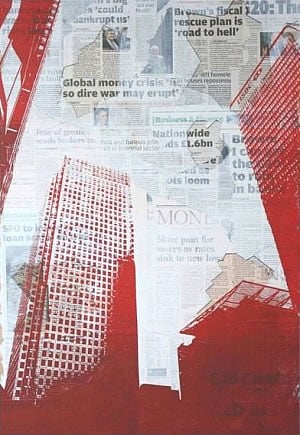
Short for 'background', a basis is the very first layer of paint (or other wet medium) applied to an artwork. Information technology is an undercoat, which tin either be covered entirely by subsequent media, or left visible in the final work.
Using a footing has several practical advantages, besides as some important artful ones. For example:
- Blending colours is easier. Nigh papers, canvases, timbers and fabrics are very porous. If you paint directly upon them, the moisture from the paint is captivated almost immediately, resulting in paint that is difficult to spread and difficult to alloy.
- Paint dries richer and more vibrant. Without a footing to 'seal' a surface, paint dries prematurely and becomes slightly flat and dull in appearance; absent of its natural sleeky sheen (if you accept never used a basis, you won't be aware of how total-bodied and beautiful pigment can look when it is allowed to slowly evaporate dry).

This painting past artist Kim Naumann has been completed on a collage of textured paper, such as wallpaper and gift cards. The blue and chocolate-brown washes over the peak has settled in the creases and indentations, highlighting the texture and creating a cute ground for the painting. - You can paint on a greater range of surfaces. Many shiny materials, particularly composite boards (such as hardboard, which contains oil) repel acrylic pigment. A professional person primer such as Gesso (see below) is designed to attach to such surfaces and to create a ground that is perfect for painting upon.
- Texture. A footing tin be used to smooth over imperfections in the underlying surface or to create new texture.
- Flimsy papers can be strengthened. A sail of newspaper becomes stiffer and more resilient when covered with a thick ground (sometimes painting both sides is necessary, in order to minimise warping). A sturdier piece of paper is especially benign if later adding collage or heavy elements to a piece of work.

This painting past artist Ian Francis has been painted on a black footing. Black forces you to apply thick (or many) layers of paint and information technology can help create deep, brooding shadows. - It allows you to easily cover underlying colours. A thick primer reduces the number of layers needed to cover a intensely coloured surface.
- Paintings can be finished faster. If a ground remains partially – or completely – visible in a finished work, the painting tin can oftentimes exist finished much faster. At a very uncomplicated level, your work is already partially done: the canvas is covered entirely from the commencement (fourth dimension is commonly of vital importance for high school art students who are obligated to complete piece of work within tight fourth dimension frames – if you need more than tips for increasing your work speed, please read How to Pigment and Draw Faster).
- Paintings tin can look more 'authentic', equally if they belonged to a 'real' artist. Why? Because grounds encourage layers and in doing so, requite a greater opportunity for the creative person to really interact with the piece of work; their soul to exist tangled within it. Layers requite history and depth.
Epitome sources: Kim Naumann, Alexander Pavely, Ian Francis and Sam Winston (below).

A striking painting by Michael Shapcott:
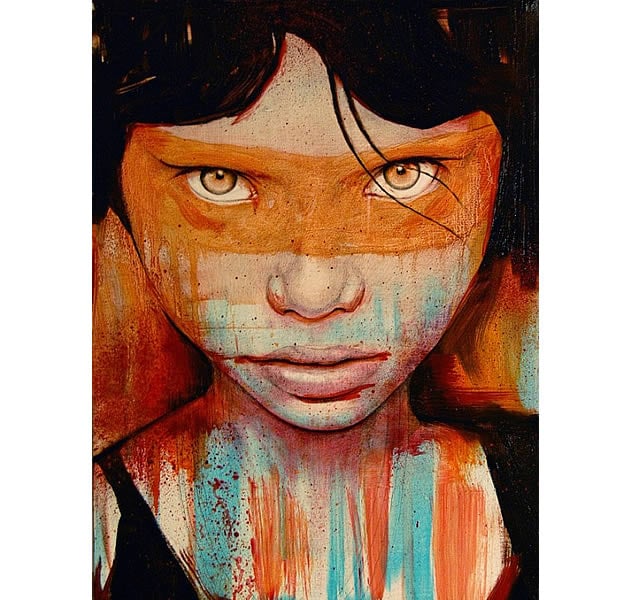
A Guide to Painting Grounds
Gesso Grounds

Gesso is a professional primer (a paint-like production that has been designed specifically for preparing a painting surface). It binds well to a range of materials and has a chalky texture that is great to paint on. It is usually thinner than paint (so spreads over larger areas easily) although unlike brands accept different consistencies. Extra thick varieties tin also exist used to create sculptural effects or sanded to a smooth finish. (I recommend Atelier gesso).
A gesso footing is generally appropriate whenever you are painting on something that is extra absorbent or paint-resistant. It is non necessary with near papers (although information technology can be advantageous, for the reasons listed above).
Gesso is typically white, still information technology comes in a range of colours as well every bit black and clear, and can be mixed with paint to create other colours.
Note: Gesso doesn't have the same glossy 'terminate' equally acrylic, so information technology is more often than not not suitable for leaving equally part of the finished visible work, unless covered with a protective surface such as glossy impasto gel or varnish.
Coloured Grounds
When selecting a coloured footing, it is advisable to employ a color that volition be prevalent in the painting, equally in the example below past Adrian Gottlieb.
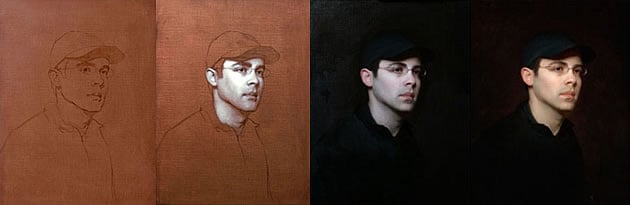
Acrylic Grounds
If yous don't have access to Gesso, pure acrylic paint (of any appropriate colour) can be used to create a ground. This can be cheaper and more user-friendly, every bit most students have a supply of acrylic paint to manus, nevertheless information technology creates a glossy surface that is sometimes difficult to paint or draw upon (although some people adopt the slicker surface to gesso'southward chalky texture). Watering the paint down (see below) volition eliminate this problem.
An acrylic ground tin also be used over the peak of gesso, or to under-paint specific areas, as in the example by Linda Isle of mann below.

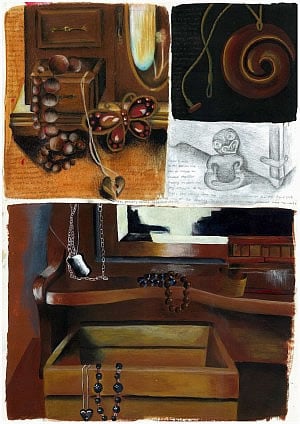
Solid acrylic grounds (likewise every bit other grounds described on this page) can form an integral part of an IGCSE / GCSE and A Level Art project. In the outstanding International GCSE sketchbook page shown to left (completed by Nikau Hindin while studying at ACG Parnell Higher) – function of an IGCSE Fine art and Pattern Coursework project that achieved 99% – three of the four studies have been completed upon an acrylic footing. Note that the edges are ragged and uneven, helping to create the feeling of an experimental 'work in progress', as is typical of a sketchbook page. As mentioned above, the colour of the each footing is the most common colour in each individual work, with large areas of the ground left visible at completion. Having a ground visible in the concluding work conspicuously speeds upwardly the painting process – a gene that is very important for A Level Art students.
The artwork to the left by Lyndon Hayes shows a contemporary approach to a ground. Not just is the brown a useful mid-tone for the flesh of the runner, a large expanse is left visible in the foreground of the work.

Messy, Textural Grounds
The real fun with grounds occurs when you begin to care for them with every bit much enthusiasm and dedication as you requite the subject field of the painting itself. Messy, gestural grounds tin exist very advisable for sketchbook exercises and, in many cases, provide welcome dissimilarity to a tightly controlled observational drawing for which high school fine art students are well known. Textural grounds tin also be used as a method for imparting texture to the objects within the artwork and for creating a visually interesting surface.

In the instance to the right, by Jane Mitchell, a semi-translucent infant's pram has been painted over a textural background – creating the impression of a decaying wall surface. The work suggests urban decay: forgotten moments in time; a snapshot of human existence in a crumbling, eroding earth.
A pastel drawing exercise by Adiefineart:

Acrylic Washes / Ink Washes / Watercolour Grounds
Captivating work past Stella Im Hultberg:

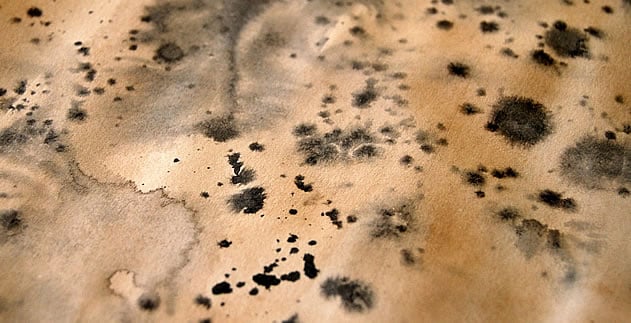
Some of my favourite grounds are those produced with watery, unpredictable mediums. A watery paint, ink or dye, with all its wild splashes, irregular runs, seeping and pooling, is the stuff of magic. When making such a watery ground, yous comprehend a sense of freedom and endless possibility. Sometimes my students will spend a whole lesson – or an evening at dwelling – making a pile of beautiful, splashy, crazy grounds. They get thick, moisture-strength paper (300gms, for example) – or scraps out of the bin – or other random things (see the previous article in this series for ideas) and dunk $.25 in water, ink or acrylic wash and lay them, dripping, on a tabular array. Then they splash colour everywhere; splatter a fine mist of inky rain.


Beautiful Indian ink splatters past Lisa Sarsfield:
An heart-catching image by graphic designer Graham Smith:

Artist Andrew Young, with drips that have run off the painting and onto the wall:

Crepitation medium
Crepitation medium tin can exist used to create a ground that has an 'old' weathered appearance. Dry-brushing tin can exist used to exaggerate the appearance of the cracks. While care should be taken to avert using mediums like this merely for the sake of it, this can exist a fun medium to experiment with.
Paradigm sourced from a great tutorial most how to make homemade crackle medium using gum by Makethebestofthings:

Shellac
Shellac is an 'olden day' varnish, bachelor through fine art shops in the form of dried shellac flakes. It is amber in colour and can exist used to seal an artwork prior to painting. Information technology is usually applied after a sketch has been done, as shellac is translucent, and the pencil lines testify through (sometimes they smudge a little). It is unremarkably necessary to complete whatsoever sketches showtime, as it is very hard to depict onto shellac with a pencil, due to its shiny, hard surface. It is sometimes difficult to paint on likewise, equally certain paints 'peel' off it.

Translucent Grounds

Gel medium can be particularly useful when painting over a surface (such every bit a map or speckled slice of timber) that has crawly marks that you want to keep.
Encaustic (wax mixed with oil pigment) tin likewise exist used when working over old salvaged materials, every bit in the awesome example to the right by Janet Nechama.
In conclusion…
Using a basis often results in the cosmos of rich, multi-layered works that take a history to them; buried marks that fill them authenticity. Instead of being superficial or surface-deep, your painting becomes the work of an creative person: filled with song.
This article is the 2d in a 4 part series about creative use of media for loftier school fine art students.
Read Part three: Beyond the Castor.
Read Part 1: How to Make your Art Project Exciting!

Amiria has been an Art & Design teacher and a Curriculum Co-ordinator for 7 years, responsible for the course pattern and assessment of student work in two high-achieving Auckland schools. She has a Bachelor of Architectural Studies, Bachelor of Architecture (First Class Honours) and a Graduate Diploma of Teaching. Amiria is a CIE Accredited Art & Pattern Coursework Assessor.
Source: https://www.studentartguide.com/articles/painting-on-grounds
0 Response to "Painting on Grounds: Inventive uses of media for Art students"
Post a Comment