How to bring nature into your home with the right houseplants
Spending more time within has accelerated whatsoever number of trends that existed before the pandemic, including bingeing of all kinds. But hither's one that's actually healthy: Bringing nature indoors.
The appeal of interiors draped in greenery is no mystery: Houseplants are a natural save for spaces filled with bogus materials and products, reminders of the far-flung gardens and landscapes that may be hard to visit these days – and even stand-ins for the friends we used to entertain in our homes.
"You can actually be a minimalist, but if yous have plants, all of a sudden the space feels warm and inviting," said Eliza Blank, the founder and chief executive of the houseplant retailer The Sill, who said her company's sales have skyrocketed over the past yr.
Maximalists have constitute their stride, too, inspiring legions of followers on Instagram with rooms that resemble private jungles. The National Gardening Association estimates that household spending on houseplants has climbed nearly 50 per cent since 2016, with a year-over-year bound of more than than 12 per cent in 2020.
READ: Cooped upwards indoors, cocky-isolating? At that place's a reason y'all don't feel well
But adding plants to your home isn't e'er every bit easy as it looks. They tin shrivel and die. And even if they live, they may non await as skilful in your domicile as they practise on Instagram.
So what's the secret to integrating plants into your living space?
"When it comes to plant styling, information technology's simply like any design project," said Justina Blakeney, the Los Angeles-based founder of the blog-cum-lifestyle-brand The Jungalow, whose latest volume, Jungalow: Decorate Wild, will exist published next month. "Y'all have to think nearly the greater context and the overall look and feel y'all're going for."
She added: "Of grade, plants are living creatures, so yous have to keep in heed what they want as well."
Blakeney and other institute stylists and designers shared their strategies.
Empathize YOUR ENVIRONMENT (AND YOURSELF)
Many houseplants suffer simply because they're put in environments that don't suit them. Only considering a big dabble-leaf fig tree looks impressive in a living room yous see in a shelter mag doesn't hateful it will look good or flourish in your living room.
"My biggest tip is to assess the light in your dwelling house outset, because light is the most important aspect of keeping plants happy," said Danae Horst, the founder of Folia Collective, a plant store in Los Angeles, and the writer of Houseplants For All. "It's more important than watering; it'due south more important than fertilising. Light is to plants as food is to humans."
READ: 'I treat them like pets': The world of Singapore'due south carnivorous plant lovers
Consider which direction your windows face up; await for obstructions from neighboring buildings or trees outside; and report the quality of calorie-free. South-facing windows normally get the most straight sunlight, Horst said, while due east- and westward-facing windows get some light, and north-facing windows get very niggling, which makes them the virtually challenging.
Then, with help from a nursery or establish guide, choose the types of plants that are best suited to your dwelling's conditions. Desert plants like cactuses and other succulents thrive in rooms that get direct sun all day long, Horst said. Tropical plants tend to fare better in rooms that get a lot of indirect, filtered or dappled light, equally they would under a canopy of trees. Serpent plants and ZZ plants can tolerate darker conditions.
Information technology'south likewise important to be realistic virtually your found-parenting skills: Are you overzealous, or more of a easily-off plant parent? Some people insist on watering every mean solar day, and drown plants that would fare better with once-a-week watering; others bring plants home and forget to water them for months, or allow the soil dry out when they travel.
Neither approach is necessarily a problem, so long as you choose the plants suited to your habits. "Agreement what is going to fit your lifestyle, and your personality, is helpful," Horst said.
Beginning WITH A Statement
For instant gratification without amassing a large collection of plants, you could start with a single, eye-catching establish, said Hilton Carter, a Baltimore-based plant and interior stylist whose latest volume, Wild Creations, will exist published next month.
"I make decisions based on what I phone call the argument institute," he said. "Information technology's the one plant that instantly grabs your attention and sets the tone."
Carter'southward habitation bursts with greenery, merely there's no missing the statement plant in his living room: A towering dabble-leaf fig tree.
Whatever found with impressively large leaves will practise the play a trick on, he said: "A larger foliage found, or a bigger plant, in most situations – it'south all about what you lot want the statement to exist."
Blakeney sometimes looks for a plant with a bright pattern. "I am a huge fan of decorating with plants the style that ane might traditionally decorate with textiles or colour," she said. "Some of my very favourite plants are ones that are polka-dotted or have stripes or bring different vibrant colours into the infinite."
But make sure to choose varieties that won't interfere with the style you utilise the space.
READ: Singapore is condign a nation of urban gardeners – but is information technology all that sustainable?
Shape, or what Summer Rayne Oakes, an entrepreneur, YouTube personality and author of How to Make A Institute Beloved Yous, calls "structure", is important. A alpine plant in a big planter is squeamish in an empty corner of a loft, but may be impractical in a tighter circulation area.
Similarly, if you use a hanging planter, "y'all might want a plant that drapes down", she said, rather than ane that reaches up to the ceiling. And in a functional space similar a kitchen, a plant on a shelf should stand up up rather than spread out, because when yous're trying to launder dishes at the sink, she said "you can't have something that'due south flailing its leaves too much".
CREATE CLUSTERS
As you lot begin adding more plants to your collection, build clusters of plants rather than spreading out the individual pots.
"I always advise people cluster plants for maximum touch on," Blank said. If you have but a few plants, she recommended making a cluster with an odd number of pots – three or five, for example.
The plants don't need to friction match: Unremarkably, the greater the multifariousness, the amend the composition volition look. "Have advantage of the natural texture and color, and pair plants with different attributes," Blank said. "One might be very structured and upright, similar a ophidian plant. One might be more than fragile and trailing, like a philodendron. And you might add a pop of colour with an anthurium."
It doesn't always require that much planning. Horst often advises people to simply identify the window in their home that gets the best light, "and and then make that your crazy establish window".
At a sunny window in her own kitchen, she suspended various plants from a ceiling rod and added others on the flooring, a stand and the tops of cabinets. "One skilful window is enough to make a large plant statement," she said.
LEVEL Upwards
Adding plants at different heights along one wall tin create the impression of a verdant garden. "I like to have plants at all levels," Blakeney said. "I ofttimes volition have plants on the floor. I'll have plants on tables, consoles or cabinets at waist level. And and so I beloved to draw the eye up with plants high on shelves and spiller plants kind of cascading down. It creates a lot of movement and a very whimsical feeling."
Carter sometimes mounts plants directly on the wall. At home, he has a propagation area where wall-mounted wood cradles hold test tubes filled with cuttings. He besides installs air plants in wall hangers and sometimes mounts staghorn ferns directly to boards every bit wall plaques.
"You tin mount a staghorn fern to any reclaimed piece of wood," he said, because information technology doesn't need to exist potted in soil. "You can utilise this particular constitute almost every bit a work of art. If you take a gallery wall, you lot tin put upwards your other art and have a piece of living art there, also."
CURATE THE CONTAINERS
Plants are the stars of the testify, but their containers have a crucial supporting function. If you use a mishmash of flowerpots, it may await chaotic. That doesn't mean the containers accept to match, but it's helpful to have a vision of what you desire to attain.
One option is to cull pots with like colours. Horst likes vintage and handmade ceramic containers with a lot of texture, simply she focuses on collecting terracotta and white pots because "they're easy to mix together", she said. "And I never have to worry about what plants are side by side to each other if I want to change things up."
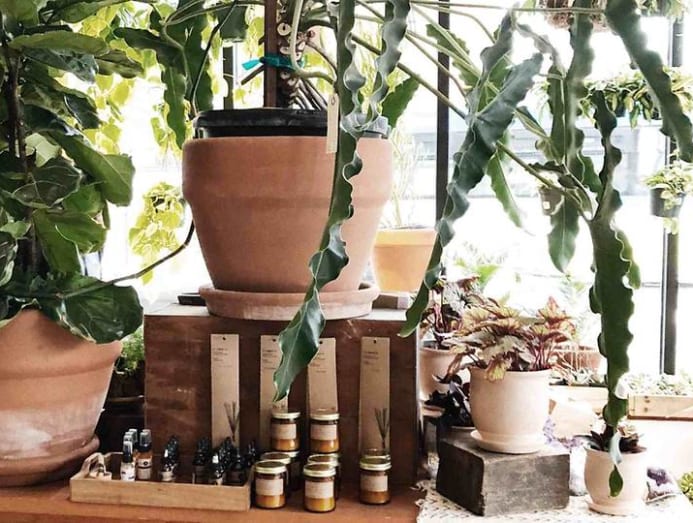
Another choice is to cull a common fabric or construction technique. Blakeney, for example, has designed rooms where plants sit in a variety of woven baskets.
But none of this means that plants necessarily accept to exist repotted, Horst noted. She often leaves them in the plastic pots from the nursery – which accept generous drainage holes and tin be easily moved to the sink for watering – and places those pots in larger ceramic containers.
"And so, when you exercise demand to repot, it'southward much easier considering the roots haven't attached themselves to the ceramic," she said. And when you find decorative pots that don't have drainage holes, at that place'southward no demand to interruption out a drill.
By Tim McKeough © The New York Times
Source: https://cnalifestyle.channelnewsasia.com/entertainment/how-to-bring-nature-inside-with-the-right-houseplants-237906
0 Response to "How to bring nature into your home with the right houseplants"
Post a Comment