Select the Sql Statement Below That Can Be Used to Delete a Database:
This commodity on the SQL Delete is a part of the SQL essential series on key statements, functions and operations in SQL Server.
To remove a row from a table is accomplished through a Information Manipulation Language, aka DML statement, using the delete keyword. The SQL delete operation is by far the simplest of all the DML commands. On execution of the delete command, we don't have to worry near getting any form of data from the table, and we don't accept to worry about working with whatsoever data that nosotros become back from the table(s). We just simply tell the database to delete a specific record, and it either does or it doesn't. It'southward that simple.
-
Note: To larn more than about how to use SQL Delete statement, delight read The Best Ways to Use SQL Delete Statement in a SQL Table article.
Offset, permit's rapidly review what an SQL delete statement looks like. We demand to tell the database and tabular array from where it should delete the data. It's a good idea to add a status clause to set the scope of data deletion. Otherwise, it will delete everything in the table.
Permit'southward take a await at our table and removing some records.
How to delete rows with no where clause
The following example deletes all rows from the Person.Person the table in the AdventureWorks2014 database. There is no restriction enforced on the SQL delete argument using a WHERE clause.
| Use Adventureworks2014 ; Get DELETE FROM [ Person ] . [ Person ] ; |
How to delete rows with where clause
The following example deletes rows from the [Person].[Person] table in the AdventureWorks2014 database in which the value in the businessEntityID column is greater than 30,000
| Utilise Adventureworks2014 ; GO DELETE FROM [ Person ] . [ Person ] WHERE businessEntityID > 30000 ; |
Note: An unfortunate fault that may occur is to accidently run a SQL Delete with no Where clause and inadvertently delete all of your information. To prevent this from happening consider using the Execution guard feature in ApexSQL Consummate, to warn against such potentially dissentious actions, before you execute them. Larn more: Execution alerts
How to delete rows using Top with where clause
The following example deletes l random rows from the Person.Person table in the AdventureWorks2014 database. The value in the BusinessEntityID must be in between 30,000 and forty,000
| USE Adventureworks2014 ; Get DELETE Elevation ( 50 ) FROM [ Person ] . [ Person ] WHERE BusinessEntityID betwixt 30000 and 40000 |
Note: The when the Pinnacle (n) clause is used with the SQL Delete statement and any DML argument (i.e. Select, Insert, Delete and Update), the operation is performed on a random selection of a number of rows specified in the Top clause.
How to delete indistinguishable rows
In the real-globe, we tend to get together information from unlike sources; information technology'due south not uncommon to take duplicate records. One arroyo to the duplicate problem is get-go to identify where the duplicates take occurred. And run a select query on those columns.
| EATE Tabular array tb_spaceused ( database_name NVARCHAR ( 128 ) , database_size VARCHAR ( 18 ) , [ unallocated space ] VARCHAR ( 18 ) , reserved VARCHAR ( 18 ) , data VARCHAR ( 18 ) , index_size VARCHAR ( 18 ) , unused VARCHAR ( 18 ) ) ; INSERT INTO tb_spaceused EXEC sp_msforeachdb @ command1 = "use ? exec sp_spaceused @ oneresultset = 1"; SELECT * FROM tb_spaceused order by database_name |
The post-obit example uses the PARTITION BY statement to segmentation the query effect ready by all the columns of tb_spaceused tabular array. The Row_Number (), a window function, which means information technology operates over an ordered set. The ORDER BY clause specified in the OVER clause orders the rows in each partitioning by the unabridged columns tb_spaceused table.
| WITH CTE AS ( SELECT * , ROW_NUMBER ( ) OVER ( Partition By database_name , database_size , [ unallocated space ] , reserved , data , index_size , unused Social club By database_name ) AS Row_Num FROM tb_spaceused ) SELECT * FROM CTE WHERE Row_Num <> 1 ; |
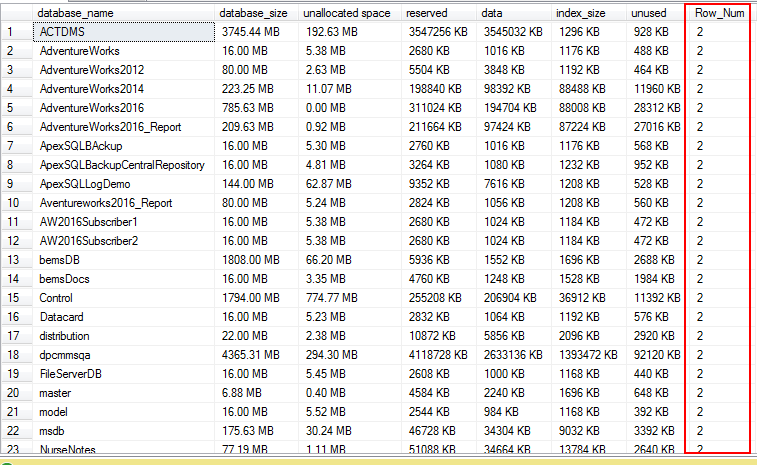
Replacing the Select statement with a Delete removes all the duplicates of the table.
| 1 2 3 four 5 vi 7 eight 9 x 11 12 13 14 xv sixteen 17 | WITH CTE Every bit ( SELECT * , ROW_NUMBER ( ) OVER ( Partitioning BY database_name , database_size , [ unallocated space ] , reserved , data , index_size , unused ORDER BY database_name ) AS Row_Num FROM tb_spaceused ) --SELECT * --FROM CTE --WHERE Row_Num <> one; DELETE FROM CTE WHERE Row_Num <> 1 ; |
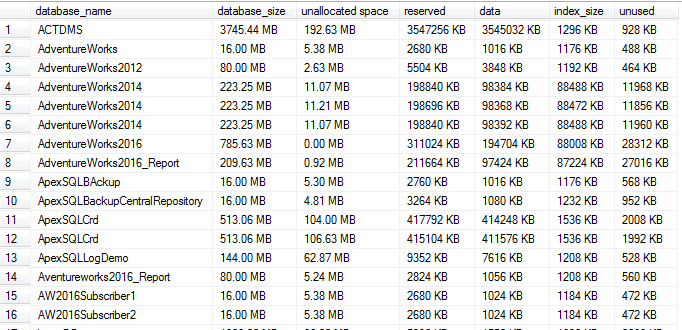
How to delete rows using SQL sub-queries
In the following instance, the rows in one table are deleted based on data in some other tabular array. In the examples, the rows from the SalesPersonQuotaHistory table are deleted based on the SalesYTD column of the SalesPerson table.
| DELETE FROM Sales . SalesPersonQuotaHistory WHERE BusinessEntityID IN ( SELECT BusinessEntityID FROM Sales . SalesPerson WHERE SalesYTD > 4900000.00 ) ; Go |
How to delete rows using SQL Joins
In this section, nosotros will utilise the SQL Delete statement to delete the data from the Adeventureworks2014 database. Deleting data, at starting time sight, sound picayune, but once we get into a large database design things might non be same and piece of cake anymore.
In many cases, the tables are related via a primary and foreign key relationship. In the following instance, we can run across a utilise of joins to delete the data from the Sales.SalesPersonQuotaHistory.
| DELETE sq FROM Sales . SalesPersonQuotaHistory sq INNER Bring together Sales . SalesPerson sp ON sq . BusinessEntityID = sp . BusinessEntityID WHERE sp . SalesYTD > 4500000.00 ; Go |
How to delete rows from a remote table using linked servers and OpenQuery
The following example uses the SQL delete statement to delete rows from a remote table using the linked server named, hqdbt01. Then query the remote table using four-part object naming convention to delete the rows from the remote tabular array
| DELETE FROM [ hqdbt01 ] . AdventureWorks2014 . [ HumanResources ] . [ Shift ] WHERE ShiftID = 2 ; |
The following example, the remote table is queried by specifying the OPENQUERY rowset office along with the delete control.
| DELETE OPENQUERY ( hqdbt01 , 'SELECT * FROM AdventureWorks2014.HumanResources.Section WHERE DepartmentID = eighteen' ) ; |
How to delete rows using SSMS
Using the SQL Server Management Studio (SSMS), Graphical User Interface (GUI) to delete rows involves a manual search. In reality, it will be much easier and quicker to delete records with a SQL query.
Let's get ahead and locate the tabular array to apply a SQL delete statement, in this instance, table dbo.cities is selected. At present, right-click and choose Edit Peak 200 rows. This selection opens up a query designer window. Side by side, right-click the window and select Execute SQL and write a new query that volition delete rows from the dbo.cities tabular array.
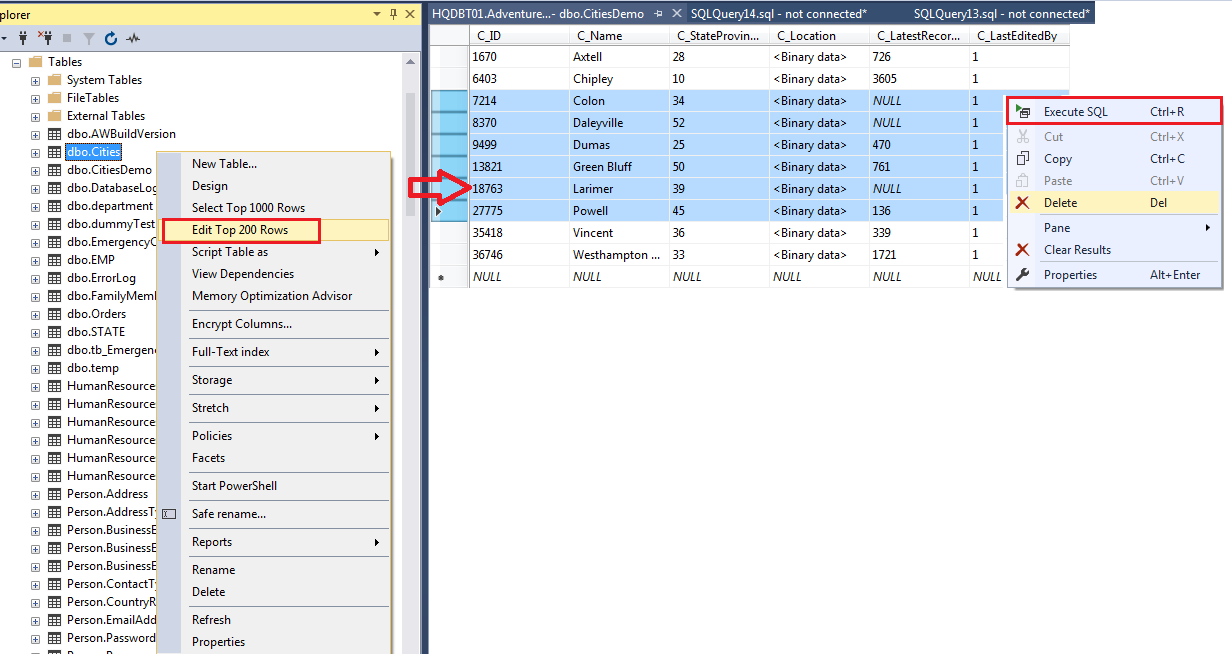
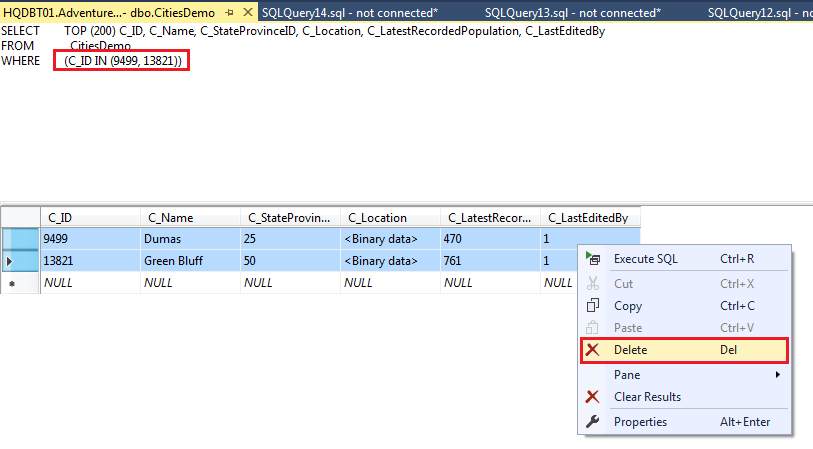
In the event pane, make sure that SELECT Statement is pulling up the correct targeted records before start deleting rows. Select the rows and right-click the rows and choose Delete to remove the rows from the table.
Summary
Thus far, nosotros've seen many unlike means use the SQL delete statement to remove data. Merely, at that place is a list of the consideration to be followed while using the delete statement, and information technology as follows:
- Information technology is always recommended to commencement with a SELECT statement before you delete anything to make sure that you're targeting the correct records. So the delete argument is used to delete rows from a tabular array using the where clause to select merely the rows to be deleted
- Always utilize a unique identifier to locate the rows that yous demand to delete
- To delete all the rows in a table, always apply TRUNCATE Table. TRUNCATE TABLE which is faster than a SQL delete statement and it uses fewer arrangement and transaction-log resource
- Past default, DELETE statements induce an exclusive (X) lock on the table, and it holds the lock until the transaction completes
- An exclusive lock prevents other transaction from modifying the information; read operations are immune with the use of NOLOCK hint or read uncommitted isolation level
- Information technology is recommended to specify the TABLOCK hint in the delete statement. This process allows page de-allocation and associated space bachelor for reuse by other objects in the database
- It is practiced do to create a clustered index on the heap table before executing a delete argument
- Although very unproblematic and very powerful, and the result of a Delete statement is destructive. Deleted rows cannot exist hands recovered
Note: To recover deleted rows see SQL Server disaster recovery – How to quickly recover data lost due to an Inadvertent delete operation
That's all for now… Hope you lot savour reading this article on the SQL delete statement. If you lot have any questions, feel gratis to comment below.
- Writer
- Recent Posts

I'yard a Database technologist having 11+ years of rich, hands-on experience on Database technologies. I am Microsoft Certified Professional and backed with a Degree in Master of Computer Application.
My specialty lies in designing & implementing Loftier availability solutions and cross-platform DB Migration. The technologies currently working on are SQL Server, PowerShell, Oracle and MongoDB.
View all posts by Prashanth Jayaram
Source: https://www.sqlshack.com/overview-of-the-sql-delete-statement/
0 Response to "Select the Sql Statement Below That Can Be Used to Delete a Database:"
Post a Comment